


The November Heating Dilemma: Adapting Older Port Jefferson Station Homes
Many homeowners mistakenly believe that if a house was built decades ago, it is permanently locked into the exact same type of heating technology it was built with. When you are upgrading your Port Jefferson Station home's heat: gas furnace vs. dual-fuel systems is a decision that actually depends far more on your current needs than your home's original blueprints. That aging furnace making unsettling noises in the basement forces a critical decision point. You have to decide whether to swap it for a similar traditional unit or make the leap to a modern dual-fuel setup.
The window to make this choice is closing fast. Achieving November pre-winter readiness is crucial before the deep coastal freezes arrive and emergency replacements become your only option. We see a rapid transition from mild Long Island autumns to freezing winter nights, which serves as the ultimate catalyst for evaluating your heating options. You need a system that adapts to both extremes efficiently.
The next step: If you are evaluating new heating systems or considering a dual-fuel heat pump, understanding how these options perform in your specific home is the first priority.
How Long Island's Coastal Climate Challenges Traditional Heating
Living on the North Shore means dealing with a highly specific weather profile. Port Jefferson Station and surrounding Long Island communities experience rapid temperature variance throughout the late fall and winter months. A mild, forty-degree afternoon can plummet into a bitter, freezing night in a matter of hours. This constant fluctuation requires a heating system that can operate efficiently across a wide range of outdoor conditions.
Furthermore, the coastal freeze aspect of our local climate changes how cold actually feels inside your home. The high humidity of ocean air pulls heat away from the body faster than dry cold air. This means your heating system has to work overtime to maintain a comfortable perceived temperature, not just a number on the thermostat. Relying on a single heat source that operates at one speed may not always be the most adaptable strategy for this specific climate profile.
The Impact of Poor Insulation in Aging Homes
Many older properties in the area present unique thermal challenges that directly impact how your heating system performs. Understanding these structural realities is essential before choosing your next unit.
• Lower R-value insulation: Homes built several decades ago often lack modern insulation standards in the walls and attic, allowing heat to escape rapidly.
• Drafty conditions: Micro-leaks around aging windows and doors mean the heating system must work harder and run longer to maintain your indoor setpoints.
• Critical high-output demands: Consistent, high-output heat becomes absolutely necessary when temperatures drop below freezing to offset the rapid heat loss through the home's exterior envelope.
The Economic Balance Point: When Dual-Fuel Systems Switch Over
To understand why a dual-fuel heat pump with gas furnace backup is so effective, you have to understand the "economic balance point." This is the specific outdoor temperature where it becomes more cost-effective and energy-efficient to heat your home with gas rather than electricity. A heat pump extracts ambient heat from the outside air and moves it indoors. While modern heat pumps are incredibly advanced, extracting heat from near-freezing air requires more electrical energy.
For most setups, the economic balance point sits right around 30 to 35 degrees Fahrenheit. Above this temperature, the electric heat pump operates with massive efficiency, often producing three units of heat for every one unit of electricity it consumes. Once the temperature drops below that threshold, the system automatically shuts off the heat pump and ignites the gas furnace backup. This automatic transition maximizes energy efficiency while guaranteeing indoor comfort during extreme cold.
Optimizing for Fall vs. Deep Winter
The beauty of a dual-fuel setup is that it does the thinking for you. You never have to manually flip a switch or guess which system should be running. If you are reading a Rheem vs. Bosch heat pumps performance review, you will notice that both brands emphasize this seamless integration.
1. Mild November days: The system relies entirely on the highly efficient electric heat pump to maintain a comfortable temperature without burning a drop of fossil fuel.
2. January coastal freezes: When the bitter cold hits, the robust gas furnace backup takes over, providing the immediate, high-temperature air needed to combat rapid heat loss.
3. Continuous optimization: The smart thermostat constantly monitors outdoor temperatures and indoor demands, switching between the two fuel sources exactly when the economic balance point is crossed.
Retrofitting Realities for Aging Houses on the North Shore
While the technology behind dual-fuel systems is impressive, installing them in older homes requires careful planning. You cannot simply drop modern, high-efficiency equipment into a fifty-year-old infrastructure without assessing the existing framework. A professional load calculation (often called a Manual J calculation) is the first mandatory step. This ensures the new system matches the home's unique thermal envelope, taking into account the exact square footage, window placement, and insulation levels.
Electrical panel requirements also play a major role in this upgrade. Upgrading to a dual-fuel system usually requires more dedicated electrical amperage than an older gas-only setup. If your home still runs on a 100-amp panel, an electrical upgrade might be necessary to safely support the heat pump's condenser unit. Working with professionals who understand historical and mid-century home construction in the area is critical. Bobby O's HVAC Inc. brings specific expertise in retrofitting older Long Island homes with modern, high-efficiency heating solutions, ensuring that the new technology integrates safely and effectively with your existing architecture.
Ductwork and Airflow Considerations
The hidden challenge in many older homes lies right above your ceiling or below your floors: the ductwork. If you are planning an HVAC replacement in Port Jefferson, duct compatibility is a major factor.
• Airflow volume requirements: Heat pumps produce a higher volume of slightly cooler air compared to the scorching hot air of a traditional furnace. This requires specific airflow volumes that older, narrower ducts might restrict.
• Modifications and sealing: Existing ductwork often needs to be sealed, insulated, or slightly modified to achieve the desired efficiency and prevent air leaks into unconditioned spaces like attics or crawlspaces.
• Preventing short-cycling: Properly sized equipment paired with capable ductwork prevents the system from short-cycling (turning on and off too rapidly), which wears out parts prematurely and causes uneven heating.
Sticking with a Traditional Gas Furnace: The Case for Familiarity
Replacing your aging unit with a new, high-efficiency gas furnace remains a highly popular choice for a reason. Traditional gas furnaces offer a straightforward replacement process and deliver incredibly reliable performance during the absolute coldest days of the year. If your priority is November pre-winter readiness with minimal disruption to your home's infrastructure, a modern gas unit is a powerful contender.
However, it is important to weigh both sides before making a final decision. Here is what you need to consider if you lean toward a traditional replacement:
• Immediate, high-heat output: Gas furnaces produce intensely hot air instantly, warming up a drafty older home very quickly regardless of how cold it gets outside.
• Lower upfront installation complexity: If your existing gas lines, exhaust venting, and electrical connections are already intact and up to code, swapping in a new furnace is generally a faster, less complex job.
• Significantly better AFUE ratings: Modern gas furnaces offer Annual Fuel Utilization Efficiency (AFUE) ratings up to 98%. This means virtually all the fuel is converted into usable heat, a massive improvement over units from 15 to 20 years ago that wasted a large percentage of their fuel up the chimney.
• The primary drawback: You are entirely reliant on a single, fluctuating fuel source. Additionally, a gas furnace operates with lower efficiency during mild late-fall weather compared to an electric heat pump, because it still burns gas to produce heat even when only a small temperature adjustment is needed.
Upgrading to a Dual-Fuel Setup: Efficiency Meets Winter Reliability
Making the leap to a dual-fuel system offers a modernized approach to home comfort. By combining an electric heat pump with a gas furnace, you gain the ability to heat your home using the most cost-effective energy source available at any given moment. This setup is particularly effective for homeowners looking to reduce their long-term energy consumption without sacrificing the heavy-duty heating power needed for a Long Island winter.
If you are scheduling an HVAC installation, here is why a dual-fuel heat pump with gas furnace backup might be the right choice:
• The best of both worlds: You get hyper-efficient electric heating for roughly 70% of the winter (during milder days and shoulder seasons) and robust gas power for the coldest 30% of the year.
• Reduced carbon footprint: By relying on electricity for a large portion of your heating needs, you significantly lower your home's direct fossil fuel consumption over the lifespan of the system.
• Potential financial incentives: Federal tax credits and local utility incentives may apply to qualifying high-efficiency installations. (We advise all readers to verify current programs with their utility provider or a tax professional to see what generic rebates they qualify for).
• The primary consideration: The initial retrofitting complexity is higher. You need adequate outdoor space for the heat pump condenser, potential electrical panel upgrades, and a thorough assessment of your existing ductwork.
Side-by-Side Comparison: Gas Furnaces vs. Dual-Fuel Heat Pumps
Synthesizing all these factors helps clarify which system aligns with your home's needs and your long-term goals. A dual-fuel heat pump with gas furnace backup offers incredible adaptability, while a standalone gas furnace provides unmatched simplicity and raw heating power. The right choice depends heavily on your existing infrastructure and how you prefer to heat your home.
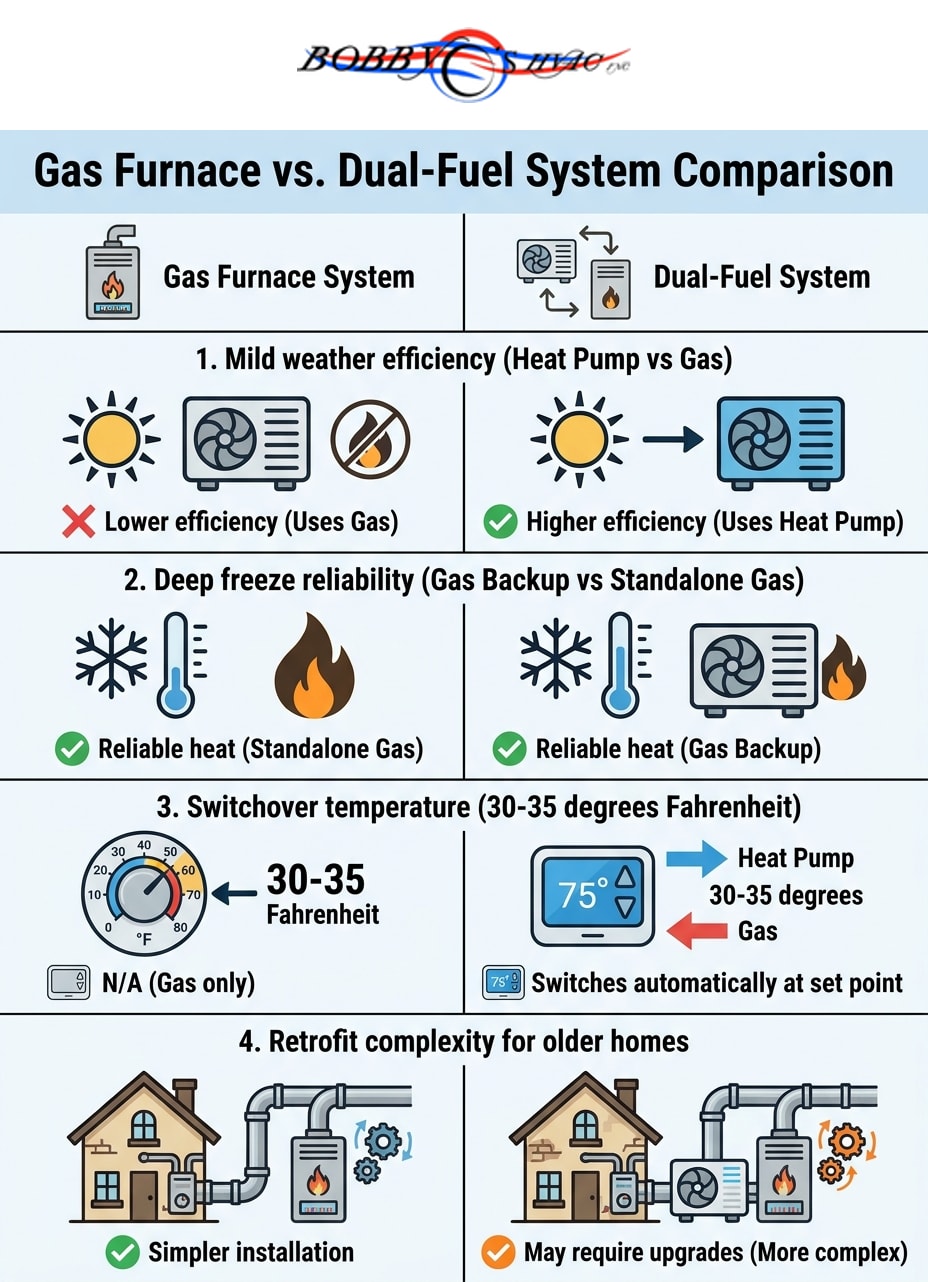
Review the comparison below to see how these two systems stack up across the most critical performance categories for Long Island homeowners.
• Mild Weather Efficiency — Traditional Gas Furnace: Moderate. Burns gas even for minor temperature adjustments. — Dual-Fuel System (Heat Pump + Gas): Exceptional. Uses the highly efficient electric heat pump for low-cost heating.
• Deep Freeze Reliability — Traditional Gas Furnace: Excellent. Provides immediate, high-heat output regardless of outdoor temps. — Dual-Fuel System (Heat Pump + Gas): Excellent. Automatically switches to the gas furnace backup when temps drop below 35°F.
• Retrofitting Older Homes — Traditional Gas Furnace: Generally simpler. Uses existing gas lines, venting, and electrical setups. — Dual-Fuel System (Heat Pump + Gas): More complex. May require ductwork modifications and electrical panel upgrades.
• Long-Term Adaptability — Traditional Gas Furnace: Locked into a single fuel source (natural gas or propane). — Dual-Fuel System (Heat Pump + Gas): Highly adaptable. Shifts between electricity and gas based on weather and efficiency.
Frequently Asked Questions About Long Island Heating Upgrades
At what temperature does a dual fuel system switch to gas?
A dual-fuel system typically switches to gas when the outdoor temperature drops to between 30 and 35 degrees Fahrenheit. This specific temperature is known as the economic balance point. At this stage, the electric heat pump becomes less efficient at extracting ambient heat, so the smart thermostat automatically shuts it down and ignites the gas furnace backup to maintain indoor comfort.
Is a dual fuel heat pump worth it in cold climates like Long Island?
Yes, a dual-fuel system is highly effective in cold climates because it offers the perfect hybrid solution. Port Jefferson Station and surrounding Long Island communities experience long stretches of mild fall and early winter weather where the heat pump operates with incredible efficiency. When the bitter coastal freezes finally arrive, the system relies on the gas furnace, ensuring you never lose heating power when you need it most.
Can I add a heat pump to my existing gas furnace?
In many cases, you can add a heat pump to an existing gas furnace, effectively creating a dual-fuel system. However, your current furnace must be compatible with the new heat pump technology, and your blower motor must be capable of handling the specific airflow requirements. A professional technician must evaluate your existing equipment, ductwork, and electrical panel to determine if an add-on installation is feasible.
What is the downside to a dual fuel heat pump in an older home?
The primary downside is the initial complexity of retrofitting the system into an older property. Older homes often have ductwork sized strictly for high-heat gas furnaces, which may restrict the higher-volume airflow required by a heat pump. Additionally, older homes may require electrical panel upgrades to safely handle the increased amperage needed to run the outdoor condenser unit.
Do dual fuel systems require special ductwork modifications?
They do not always require entirely new ductwork, but modifications or sealing are frequently necessary. Because heat pumps deliver a higher volume of slightly cooler air than a traditional furnace, narrow or leaky ducts can cause airflow restrictions and reduce overall efficiency. A professional load calculation will determine if your current ductwork needs adjustments to support a dual-fuel setup.
Secure Your Winter Comfort Before the December Freeze
Choosing the right heating system ultimately depends heavily on your home's specific ductwork, its current insulation levels, and your long-term energy efficiency goals. Achieving November pre-winter readiness ensures that your family stays comfortable and safe before emergency situations arise. Making this upgrade now, while the weather still permits smooth and straightforward installations, is the smartest move you can make for your home. Schedule a professional assessment today to determine the best path forward and secure your winter comfort with a new gas furnace or a modern dual-fuel heat pump.
Customer Testimonials
Hear directly from homeowners who trust Bobby O’s HVAC Inc. for fast response times, honest service, and lasting comfort.

I got 3 estimates for the job but only Bobby O’s knew about rebates etc. the workmanship was outstanding and Armond really knows his stuff and is a true craftsman, something that is in short supply these days.

Competitive pricing. Nice, easy, and clean installation. No problems for a long time. When there was a hiccup, the problem immediately. Highly recommend.
Our AC stopped working in the middle of the heat wave. Called the company and they were able to get a tech out the same day to get us up and running. Great service!!
Quality professional service in a timely manner. Highly experienced in the industry. Great troubleshooting skills
I’ve had a service contract with Bobby O’s for about 6 years. They are always responsive, professional and thorough.
Compressor stopped working as I am on a service plan response was same day
and all was made right
My bedrooms had no AC!
They came and quickly evaluated the problem, replaced the bad part and I soon had complete cool AC everywhere.
Rate was very reasonable!
This was a fabulous experience. Most people don't even return your call. Bobby returned call right away, and at my house the next day!!
Fixed the issue!!! And on top of it gave me a great price!!! I totally recommend him!!!
Bobby is great! He was extremely helpful and accommodating to get my heat back running again at a reasonable price. Highly recommend
I was referred to Bobby O's HVAC through a friend. They came the very next morning, assessed the problem. I chose to replace rather than repair. They were fair, efficient, neat, extremely professional and fast!


