


When Your AC Won't Stop Running: Facing the Late-Summer Cooling Dilemma
Your air conditioner is running nonstop, but the house still feels uncomfortably warm. When faced with this frustrating scenario, getting common homeowner questions answered right away can mean the difference between a quick fix and a total system breakdown. By the time August rolls around, your cooling system has been working hard for months. This late-summer period is when cumulative wear and tear finally catches up with aging equipment, often revealing underlying issues that were easily ignored in June.
For comprehensive solutions and professional guidance, explore our air conditioning services.
The Breaking Point of Late Summer
Most homeowners assume that if the air conditioner is running, it must be working. However, a system that refuses to cycle off is a system in distress. When the thermostat is set to 72 degrees but the indoor temperature stubbornly hovers at 78 degrees, your equipment is consuming massive amounts of electricity without delivering the expected comfort. This continuous operation puts immense strain on the compressor, the blower motor, and the electrical components.
The core decision point: When you notice this symptom, you are immediately faced with a choice. Is this a basic airflow restriction that can be resolved with a quick maintenance task, or is it a sign of a severe mechanical failure that warrants a broader discussion about repairing versus replacing the unit? Understanding the root causes of continuous running is the first step toward making an informed, confident decision about your home's comfort system.
The Impact of High Humidity on Aging Cooling Systems
To understand why an air conditioner runs endlessly without cooling the house, you first have to understand the two distinct jobs your cooling system performs. Lowering the ambient air temperature is known as the sensible cooling load. Removing moisture from the air is known as the latent cooling load. In a coastal climate like Long Island, late-summer humidity drastically increases this latent load.
How Coastal Humidity Stresses Your System
During a humid August heatwave, the air inside your home is heavy with moisture. Before your air conditioner can effectively lower the temperature of the room, it must first extract gallons of water from the indoor air. The system accomplishes this by drawing warm, moist air over the cold evaporator coil, where the moisture condenses into water and drains away. Only after a significant amount of humidity is removed will the thermostat register a drop in temperature.
The aging equipment struggle: Older cooling systems often lack the efficiency and advanced technology required to handle intense humidity efficiently. As compressors age and coils accumulate years of microscopic dust, their ability to transfer heat and remove moisture diminishes. Consequently, an older unit will run continuously, struggling to overcome the high latent heat load. The system is working twice as hard just to dehumidify, leaving very little capacity to actually cool the air.
Modern systems, by contrast, are specifically engineered to manage heavy moisture loads more effectively. They operate at optimal speeds to extract humidity without running at maximum capacity 24/7, providing a stark contrast to the endless, noisy operation of an outdated unit.
Airflow Issues: What Homeowners Can Safely Check
Before assuming your constantly running air conditioner requires a major mechanical overhaul, it is critical to rule out basic airflow restrictions. Restricted airflow is one of the most common reasons a system fails to reach the set temperature. When air cannot move freely through the system, the cooling cycle is disrupted, and the unit runs continuously in a futile attempt to compensate.
For ongoing peace of mind and optimal performance, many homeowners benefit from enrolling in a routine HVAC maintenance plan.
Safe DIY Troubleshooting Checklist
There are several safe, straightforward checks you can perform before calling a professional:
• Inspect the air filter: A clogged, dirty air filter is the primary culprit for restricted airflow. When the filter is blocked, the blower motor has to work harder to pull air through, and the cold evaporator coil can literally freeze over into a block of ice, halting the cooling process entirely.
• Check all indoor vents: Ensure that all supply registers and return grilles are fully open and unobstructed by furniture, rugs, or heavy drapes. Closing vents in unused rooms does not save energy; it actually increases pressure inside the ductwork and forces the system to run longer.
• Clear the outdoor unit: The outdoor condenser needs plenty of space to release the heat it absorbed from your home. Remove any leaves, overgrown shrubs, or debris within a two-foot radius of the outdoor cabinet.
The strict boundary for homeowners: While changing filters and clearing debris are safe tasks, anything involving the electrical panel, opening the equipment cabinet, or handling refrigerant requires a licensed professional. Interestingly, basic maintenance can have profound effects. In one local instance, a homeowner with a 15-year-old air conditioner that had not been serviced in years found that a meticulous professional cleaning and a simple filter change completely restored the unit, making it run like new again without the need for major repairs.
Diagnosing Deeper Issues: Mechanical and Refrigerant Failures
If you have replaced a dirty filter and ensured all vents are clear, yet the system continues to run constantly while blowing lukewarm air, the problem likely lies deeper within the system. At this stage, the issue has moved beyond basic homeowner maintenance and into the realm of mechanical or chemical failure.
Warning Signs of Major System Malfunctions
A continuous cooling cycle often points to a loss of cooling capacity. One frequent cause is a refrigerant leak. Refrigerant is the lifeblood of the system; it absorbs heat from inside the home and carries it outside. If microscopic holes develop in the copper lines or coils, the refrigerant level drops. With low refrigerant, the system simply cannot absorb enough heat, forcing it to run endlessly to try and reach the thermostat setting.
Mechanical failures are another common culprit. The blower motor is responsible for circulating conditioned air throughout the ductwork, while the compressor pumps the refrigerant through the lines. If either of these components begins to fail, the entire cooling cycle is compromised. Paying attention to unusual sounds is crucial. For example, if you notice that your AC system is making grinding noises, it is a strong indicator of failing mechanical parts.
A typical pattern we see involves a system making excessive noise and failing to blow air during extreme summer heat. In one such case, a local customer required a complete blower motor replacement and a system recharge. Once the burnt-out motor was replaced by a professional, the system returned to blowing colder air than it had in years. Professional diagnostics are absolutely essential here to pinpoint whether the root cause is a minor electrical fault, a slow refrigerant leak, or a failing compressor.
Evaluating the 50% Rule for AC Repair vs. Replacement
When professional diagnostics reveal a significant mechanical failure, homeowners inevitably face a difficult decision: pour money into repairing an aging unit, or invest in a brand-new system. The HVAC industry relies on a standard guideline known as the 50% rule to help clarify this choice.
Understanding the 50% Rule
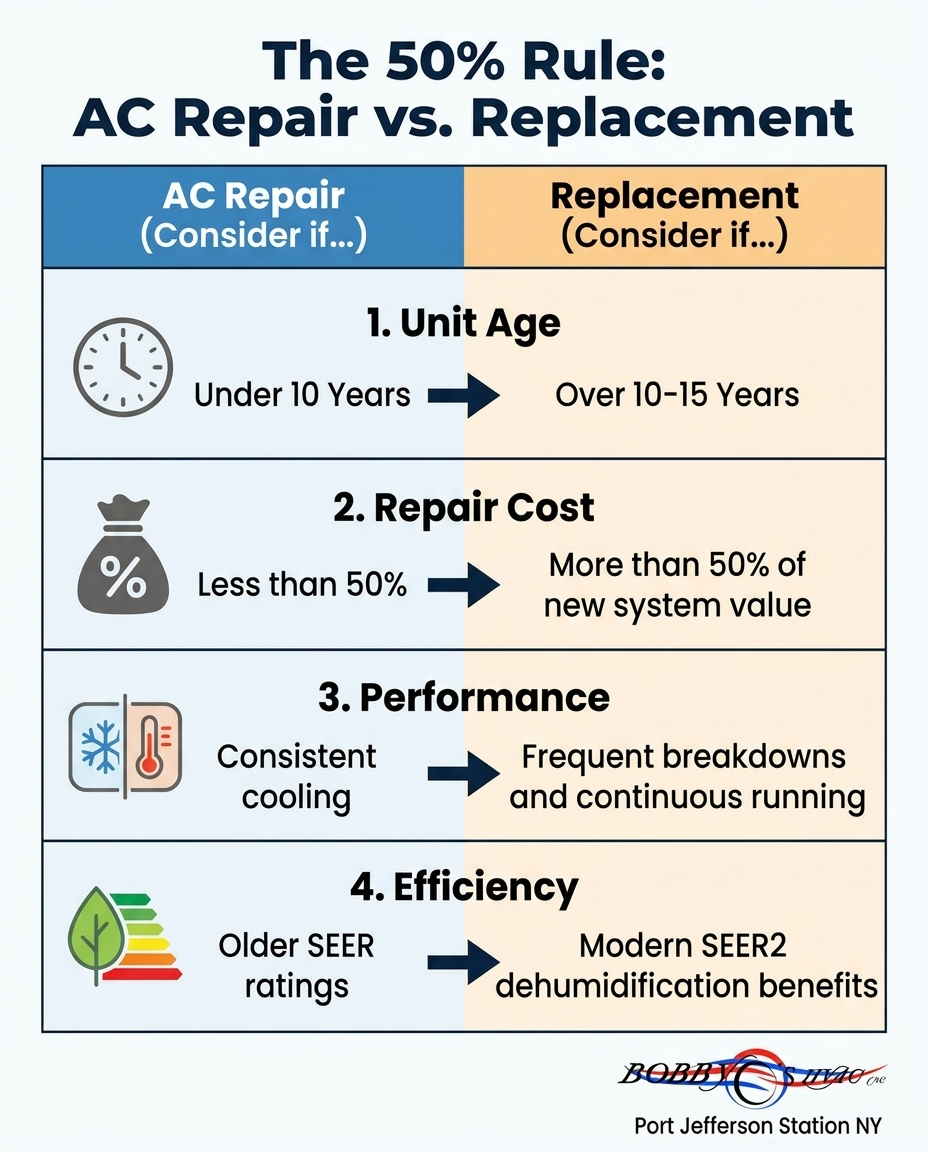
The 50% rule is straightforward: if the cost of a required repair approaches or exceeds half the value of a new, comparable system, replacement is generally the wiser financial decision. However, the repair cost is not the only factor to consider. The age of the unit plays a massive role. Most traditional air conditioners have an expected lifespan of 10 to 15 years. If your system is 12 years old and requires a major compressor replacement, investing heavily in a unit that is nearing the end of its functional life is rarely advisable.
When weighing the options for an HVAC repair, you must also account for cumulative costs. Frequent breakdowns add up quickly. If you are calling for service multiple times a season, those service fees and minor part replacements often equal the cost of a new system over time. Furthermore, generic energy rebates or federal tax credits for upgrading to high-efficiency equipment can significantly alter the math, making replacement more appealing.
In one recent situation, a homeowner referred for a next-morning assessment was facing this exact dilemma. After technicians evaluated the extensive wear and tear on the aging equipment, a full unit replacement proved to be the most fair, efficient, and reliable solution compared to a temporary, expensive patch.
• System Age — Lean Toward Repair: Under 10 years old — Lean Toward Replacement: Over 10-15 years old
• Repair Cost — Lean Toward Repair: Less than 50% of a new system — Lean Toward Replacement: More than 50% of a new system
• Reliability — Lean Toward Repair: Rarely breaks down — Lean Toward Replacement: Frequent failures and continuous running
• Efficiency — Lean Toward Repair: Acceptable energy bills — Lean Toward Replacement: High utility bills, poor dehumidification
Long-Term Value: How Modern SEER Ratings Improve Comfort
If the 50% rule points you toward replacement, it is important to understand the long-term value that modern cooling technology provides. Today's air conditioners are vastly superior to the models manufactured just a decade ago, particularly in how they handle energy consumption and humidity control.
The SEER2 Difference
Air conditioner efficiency is measured by the Seasonal Energy Efficiency Ratio, recently updated to the SEER2 standard. This rating measures how much cooling a system delivers per watt of electricity consumed over an entire cooling season. Higher SEER2 ratings directly correlate with lower energy consumption. Replacing an outdated, constantly running unit with a modern, high-efficiency model stops the endless cycle of wasted electricity, leading to substantial long-term energy savings.
The variable-speed advantage: One of the most significant advancements in modern HVAC technology is the variable-speed compressor. Older systems operate on a single-stage basis—they are either 100% on or 100% off. This leads to abrupt temperature swings and poor moisture removal. Variable-speed units, however, can adjust their output dynamically, running at lower speeds for longer periods. This might sound counterintuitive, but running at a low, steady speed uses far less energy than constantly turning on and off. More importantly, this steady operation allows the system to continuously extract humidity from the air, preventing the heavy, sticky feeling that plagues older homes in late summer.
Common Homeowner Questions Answered: Troubleshooting Constant Running
When an air conditioner acts up, homeowners naturally have immediate questions. Here are clear, concise answers to the most frequent troubleshooting inquiries regarding continuous operation.
Why does my AC run constantly but not reach the thermostat setting?
This usually indicates a severe loss of cooling capacity. The system is trying to reach the set temperature, but restricted airflow, low refrigerant levels, or extreme outdoor heat exceeding the system's design limits prevents it from producing enough cold air. The thermostat keeps the system running because the target temperature is never achieved.
Is it normal for my AC to run all day in August?
During peak heat and humidity, systems will naturally run longer cycles to manage the heavy latent and sensible cooling loads. However, they should eventually cycle off. Running 24/7 without a single break signals a problem, meaning the system is either undersized for the home, suffering from restricted airflow, or failing mechanically.
Should I repair or replace my air conditioner?
The decision depends heavily on the unit's age, the severity of the malfunction, and the 50% rule. If the unit is over 10-15 years old and the repair costs exceed half the value of a new system, replacement is generally recommended. A professional assessment is required to make an informed, financially sound choice.
What causes an AC to blow warm air while running?
Blowing warm air is often caused by a frozen evaporator coil (usually due to a dirty filter), a significant refrigerant leak, or a failing compressor that has stopped pumping refrigerant through the lines. When the heat transfer process breaks down, the blower simply circulates unconditioned ambient air throughout the house.
When should I call a professional for an AC that won't stop running?
You should call an expert immediately if you have already changed the air filter, checked that all vents are open, and cleared debris from the outdoor unit, but the system still runs continuously without cooling the home. Continuing to run a malfunctioning system can cause catastrophic damage to the compressor.
Frequently Asked Questions
Why does my AC run constantly but not reach the thermostat setting?
This symptom points to a loss of cooling power. It is typically caused by a dirty air filter blocking airflow, a refrigerant leak, or an aging compressor that can no longer keep up with the heat load.
Is it normal for my AC to run all day in August?
While longer cooling cycles are expected during intense late-summer heatwaves, your system should still cycle off periodically. If it runs continuously for 24 hours without stopping, it requires troubleshooting.
Should I repair or replace my air conditioner?
Apply the 50% rule: if the repair costs more than half of a new unit's value, and the current system is over a decade old, replacement is usually the better long-term investment.
What causes an AC to blow warm air while running?
Warm air from the vents usually means the heat transfer process has stopped. This is most commonly due to a frozen indoor coil, low refrigerant levels, or a broken outdoor compressor.
When should I call a professional for an AC that won't stop running?
Contact a licensed technician as soon as you have verified the air filter is clean and the vents are open. Delaying a service call can lead to an overheated, permanently damaged compressor.
How does high humidity affect my air conditioner's performance?
High humidity forces the air conditioner to work significantly harder. The system must extract the excess moisture from the indoor air before it can effectively lower the ambient temperature, leading to longer run times.
Get an Honest Assessment for Your Cooling Needs
Continuous running is a glaring symptom that should never be ignored, especially late in the cooling season when equipment is already stressed. Whether the issue stems from a simple clogged filter or a complex compressor failure, getting a proper diagnosis is the only way to identify the true root cause. We are committed to providing honest assessments, ensuring you get the exact recommendation for your specific situation rather than a forced upsell you don't need.
If your system is struggling to keep up with the late-summer heat, now is the time to schedule an inspection to weigh all your options clearly. Reach out today to discuss HVAC replacement in Port Jefferson or to find out if a targeted repair is all you need to restore your home's comfort.
Customer Testimonials
Hear directly from homeowners who trust Bobby O’s HVAC Inc. for fast response times, honest service, and lasting comfort.

I got 3 estimates for the job but only Bobby O’s knew about rebates etc. the workmanship was outstanding and Armond really knows his stuff and is a true craftsman, something that is in short supply these days.

Competitive pricing. Nice, easy, and clean installation. No problems for a long time. When there was a hiccup, the problem immediately. Highly recommend.
Our AC stopped working in the middle of the heat wave. Called the company and they were able to get a tech out the same day to get us up and running. Great service!!
Quality professional service in a timely manner. Highly experienced in the industry. Great troubleshooting skills
I’ve had a service contract with Bobby O’s for about 6 years. They are always responsive, professional and thorough.
Compressor stopped working as I am on a service plan response was same day
and all was made right
My bedrooms had no AC!
They came and quickly evaluated the problem, replaced the bad part and I soon had complete cool AC everywhere.
Rate was very reasonable!
This was a fabulous experience. Most people don't even return your call. Bobby returned call right away, and at my house the next day!!
Fixed the issue!!! And on top of it gave me a great price!!! I totally recommend him!!!
Bobby is great! He was extremely helpful and accommodating to get my heat back running again at a reasonable price. Highly recommend
I was referred to Bobby O's HVAC through a friend. They came the very next morning, assessed the problem. I chose to replace rather than repair. They were fair, efficient, neat, extremely professional and fast!