


Is That Grinding Noise Normal for an AC in September?
Have you noticed an unsettling, harsh sound when your cooling system kicks on during these late-season warm spells? Understanding Why Your AC Grinds When Starting After a Long Port Jefferson Summer is critical for homeowners who want to protect their equipment. If you are searching online about an ac grinding noise when starting, you are likely dealing with a system that has been pushed to its absolute limits over the past few months. That jarring noise from your outdoor condenser unit is your system's way of crying out for help.
The immediate decision point you face is determining whether this is a minor electrical issue, like a worn contactor, or a major mechanical failure, such as a struggling compressor. Many homeowners wonder if they should call a professional right away or try to limp through the rest of the season. Fortunately, a loud noise does not automatically mean you need a total system replacement. For reliable Air Conditioning Services, our team at Bobby O's HVAC Inc. has spent years answering calls about these exact late-summer mechanical issues, and we are here to help you navigate them.
How Port Jefferson's Climate Accelerates End-of-Season Wear
By the time the September / early fall transition arrives, your air conditioning system has likely logged hundreds of hours of high-load runtime. A typical condenser unit works tirelessly through July and August, battling intense heat and humidity to keep your indoor environment comfortable. This continuous operation under high demand causes significant mechanical and electrical fatigue across every component in the system.
In our experience serving Port Jefferson Station NY, we've seen firsthand how our unique coastal climate adds an extra layer of environmental stress to your outdoor equipment. Coastal environments specifically impact outdoor condenser components in ways that inland systems rarely experience. The combination of coastal humidity and salt air can rapidly accelerate the degradation and pitting of outdoor electrical components over a long summer. If you need HVAC Repair in Port Jefferson, understanding how the local climate affects your machinery is the first step toward preventing premature breakdowns.
The Science of Coastal Wear and Tear
To fully grasp why your system is struggling now, it helps to look at the specific environmental factors at play:
• High-Humidity Operation: Continuous moisture in the air forces your system to run longer cycles to dehumidify the home, increasing the workload on the compressor and fan motor.
• Salt Air Corrosion: Even trace amounts of airborne salt can settle on exposed electrical contacts, accelerating rust and pitting on sensitive metal surfaces.
• Thermal Cycling: The constant switching on and off during hot afternoons and cooler evenings causes metal components to expand and contract repeatedly, leading to mechanical fatigue.
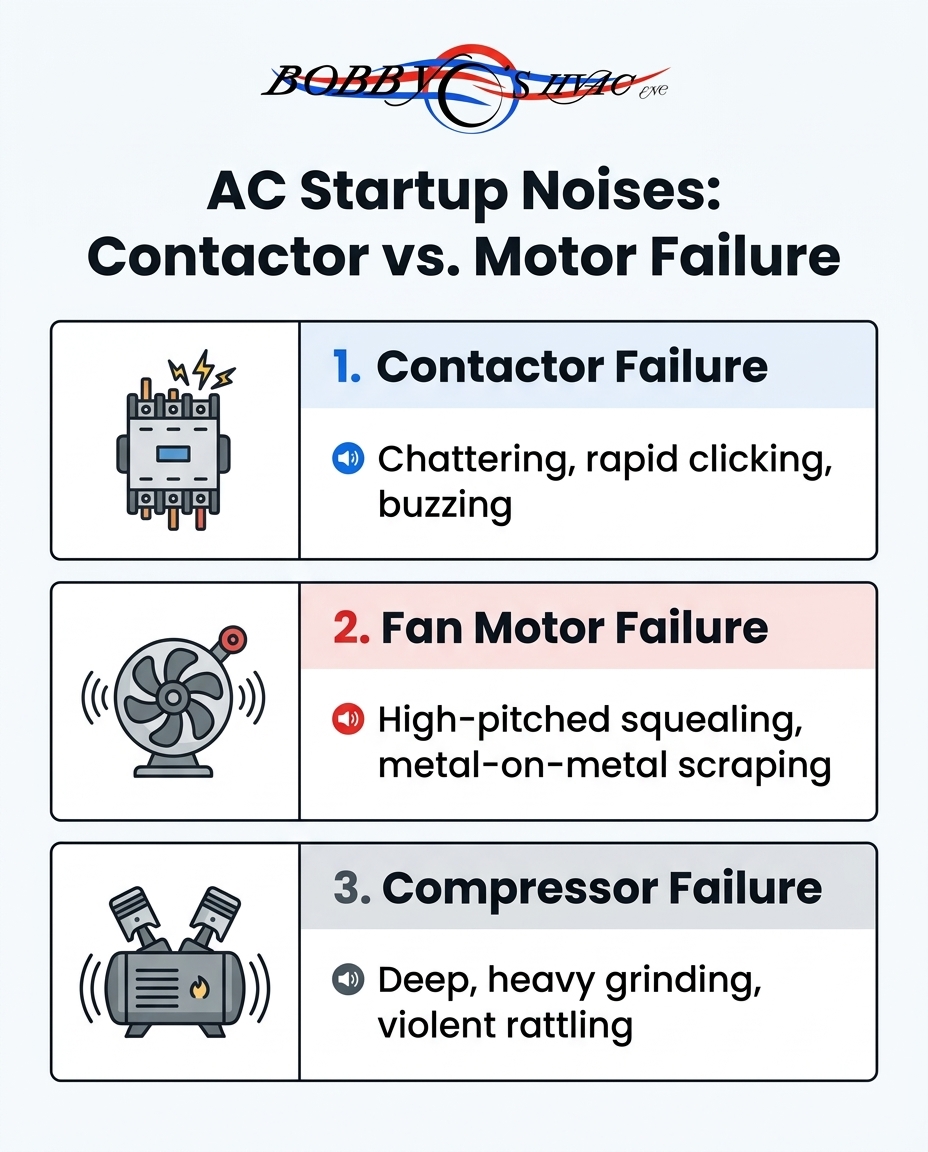
• Electrical Contactor — Summer Environmental Impact: Frequent arcing and salt-air pitting — Typical September Symptom: Loud buzzing or chattering on startup
• Fan Motor Bearings — Summer Environmental Impact: Thermal breakdown of internal lubricants — Typical September Symptom: High-pitched squealing or metal grinding
• Compressor Unit — Summer Environmental Impact: Hundreds of hours of high-pressure workload — Typical September Symptom: Heavy, vibrating mechanical rattle
By late summer, the cumulative effect of these factors reaches a tipping point. Parts that were functioning perfectly in May are now worn, dry, or pitted, resulting in the harsh startup noises that prompt emergency service calls to our dispatch team.
Electrical Chattering vs. Mechanical Grinding: The AC Contactor
When you hear a frightening noise from your condenser, the first suspect is often the AC contactor. The contactor is a critical electrical switch located inside the outdoor unit. Its primary role is to supply high-voltage power to the compressor and the condenser fan motor when your thermostat calls for cooling. It operates using an electromagnetic coil that pulls a set of metal contacts together to close the circuit.
After a long season of heavy summer use, these electrical contacts begin to pit and burn. Every time the contactor closes, a small electrical arc occurs. Over thousands of cycles, combined with the coastal air, the smooth metal surfaces become scarred, blackened, and uneven. When our technicians arrive to investigate why your AC system is making grinding noises, a failing contactor is one of the most common culprits we find.
The distinct sound of a failing contactor: A struggling contactor often produces a loud chattering, buzzing, or grinding noise as it fails to engage properly. Because the pitted metal surfaces can no longer make a clean, solid connection, the electromagnetic coil struggles to hold the switch closed, resulting in a rapid, vibrating chatter that sounds remarkably like mechanical grinding.
What We Look for During a Contactor Inspection
While a chattering contactor sounds alarming, it is a relatively minor diagnostic fix, not a catastrophic failure. When our professionals evaluate your system, we follow a strict diagnostic process:
• Visual Inspection of Contacts: Checking for deep pitting, burn marks, or melted plastic around the switch housing.
• Voltage Testing: Ensuring the coil is receiving the correct low-voltage signal from the thermostat to pull the contacts closed.
• Resistance Checks: Measuring the electrical resistance across the closed contacts to verify a solid connection without excessive heat buildup.
Replacing a worn contactor early prevents electrical arcing from damaging the much more expensive compressor motor, saving you from a massive headache down the road.
Dried Out Bearings and Failing Fan Motors
The second most common cause of grinding noises during the September / early fall transition is mechanical friction within the condenser fan motor. The fan motor is responsible for pulling air through the condenser coils to dissipate the heat removed from your home. To operate smoothly, the motor relies on bearings that are sealed and packed with heavy-duty lubricant at the factory.
However, these sealed fan motor bearings can eventually dry out after extensive continuous use. The intense heat generated by the motor itself, combined with the ambient summer temperatures, slowly degrades the internal grease. Once the lubrication fails, you are left with true metal-on-metal friction. This produces a distinct grinding or high-pitched squealing sound that continues as long as the fan is spinning.
Catching a noisy blower or fan motor early is vital. If ignored, the increased friction causes the motor to overheat and eventually seize completely. A seized motor can cause the system to overheat, leading to blown capacitors, damaged wiring, or even a ruined control board. Staying on top of routine HVAC maintenance is the best way to ensure these bearings are inspected before they fail.
Real-World Impact of Motor Failure
During a recent late-season warm spell, a local homeowner noticed their AC was making a loud thumping noise and had completely stopped blowing cold air. Our crew at Bobby O's HVAC Inc. arrived to find that the blower motor had failed under the extreme strain. We quickly diagnosed the issue, secured the necessary replacement part, and had the new motor installed within hours. Because they reached out as soon as the noise started, the system was repaired efficiently, and the AC began blowing colder air than before the incident.
Signs your motor bearings are failing:
• A grinding noise that starts slow and speeds up as the fan blade gains momentum.
• The top of the outdoor unit feels excessively hot to the touch.
• The fan blade wobbles or struggles to spin freely when the system is off (a professional will check this by hand).
When the Grinding Means a Struggling Compressor
While we always hope for a minor electrical fix or a simple fan motor swap, sometimes an ac grinding noise when starting points to the heart of the system: the compressor. The compressor motor is essentially a powerful pump responsible for pressurizing the refrigerant and circulating it between the indoor and outdoor units. It operates under immense pressure and requires precise internal mechanics to function.
When a compressor begins to fail mechanically internally, the sound is unmistakable. Unlike the rapid electrical chatter of a contactor or the squeal of a fan motor, a failing compressor produces a deep, heavy grinding or violent rattling sound. It often sounds like rocks are tumbling around inside a metal tin. This noise indicates that internal valves, pistons, or scroll plates are breaking down and colliding with one another.
The Importance of Honest Diagnostics
Hearing a heavy mechanical grind can induce immediate panic, but professional diagnostics are absolutely critical before jumping to conclusions. A bad run capacitor or a severely pitted contactor can occasionally mimic the sounds of a dying compressor by failing to deliver the proper voltage, causing the compressor to struggle and vibrate violently on startup.
This is where our commitment to honest diagnostics makes all the difference. We systematically rule out minor electrical issues before ever suggesting a costly compressor replacement. We test the capacitor, inspect the contactor, and measure the electrical draw of the compressor to ensure the problem is truly mechanical and not just a starved electrical supply. You deserve a clear, accurate picture of your equipment's health without unnecessary alarm.
Frequently Asked Questions About AC Startup Noises
Why does my AC sound like it's grinding when starting?
An AC grinding noise when starting is typically caused by one of three major issues. The top culprits are a worn electrical contactor, failing fan motor bearings, or a struggling compressor motor. After a long summer of continuous use, these components suffer from mechanical fatigue, dried-out lubrication, or pitted electrical contacts. A professional inspection is necessary to pinpoint exactly which component is generating the noise.
Is it safe to run my AC if it makes a grinding noise?
No, you should turn the system off immediately at the thermostat. Running a system with mechanical friction or electrical arcing can cause cascading damage to other expensive components. For example, a failing fan motor can cause the entire system to overheat and damage the compressor, turning a manageable repair into a major system overhaul.
What is the difference between a bad contactor and a bad compressor motor?
The difference lies in the type of sound and the source of the failure. A bad contactor produces a chattering, rapid buzzing, or electrical clicking noise as the relay struggles to close its pitted contacts. In contrast, a bad compressor motor produces a heavy, vibrating, mechanical grind that sounds like loose metal parts colliding deep inside the unit.
What does a bad AC contactor sound like?
A bad AC contactor sounds like a distinct, rapid clicking, loud buzzing, or harsh humming noise that occurs the exact moment your thermostat calls for cooling. Because the electrical contacts are worn and uneven, the magnetic coil cannot hold them tightly closed, causing them to bounce rapidly against each other and create that alarming electrical chatter.
Should I fix my AC if summer is almost over?
Yes, you should absolutely address the issue before transitioning to the heating season. Ignoring a failing component in September can lead to a complete system lockup, potentially welding the contactor shut or damaging the shared control board. Fixing it now ensures your HVAC system is safe and ready for the winter months.
Why Limping Through the Rest of September is a Gamble
As we transition into early fall, our team frequently hears from homeowners who want to just deal with the noise for the last few warm weeks. Many assume that since they only need the air conditioning for a few more days, they can simply ignore the grinding and worry about it next spring. This psychological temptation to "limp through" is one of the most dangerous gambles you can take with your HVAC system.
The risks of ignoring a struggling component are severe. If a failing contactor is left to chatter and arc, the excessive heat can eventually cause the metal contacts to weld completely shut. When a contactor welds shut, the outdoor unit will run continuously, even when the thermostat tells it to stop. This leads to the indoor coil freezing into a solid block of ice, potentially causing water damage when it thaws, and putting immense strain on the compressor. Similarly, a failing fan motor can burn out completely, sending a power surge back through the system that fries the main control board.
The Domino Effect of Ignored Repairs
Small problems rarely stay small in complex mechanical systems. Addressing cooling issues now is vital before you transition the HVAC system to heating mode. One customer, who has relied on our team for annual maintenance since 2011, knows the value of proactive care. They appreciate that we are fast to respond to scheduling calls and arrive on time to handle their equipment efficiently and professionally. By not waiting for a total breakdown, they avoid the stress of emergency failures.
If you want to avoid these cascading failures, the smartest move is to schedule an end-of-season AC tune-up. One of our technicians can clean the debris, test the electrical loads, and replace a worn contactor before the resulting strain destroys a vital, major component like your compressor.
Get an Honest Diagnosis Before the Heating Season Begins
Hearing an ac grinding noise when starting is stressful, but a scary noise doesn't automatically mean a total system replacement. Whether your system is suffering from a pitted contactor, dried-out fan motor bearings, or a tired compressor, getting an accurate, professional diagnosis is the only way to know for sure.
Don't let the fear of a major repair keep you from making the right call. At Bobby O's HVAC Inc., we encourage you to schedule a professional inspection to get a clear, non-alarmist explanation of your equipment's health. By taking action now, you can resolve the issue, prevent further damage, and gain total peace of mind heading into the crisp fall months.
Customer Testimonials
Hear directly from homeowners who trust Bobby O’s HVAC Inc. for fast response times, honest service, and lasting comfort.

I got 3 estimates for the job but only Bobby O’s knew about rebates etc. the workmanship was outstanding and Armond really knows his stuff and is a true craftsman, something that is in short supply these days.

Competitive pricing. Nice, easy, and clean installation. No problems for a long time. When there was a hiccup, the problem immediately. Highly recommend.
Our AC stopped working in the middle of the heat wave. Called the company and they were able to get a tech out the same day to get us up and running. Great service!!
Quality professional service in a timely manner. Highly experienced in the industry. Great troubleshooting skills
I’ve had a service contract with Bobby O’s for about 6 years. They are always responsive, professional and thorough.
Compressor stopped working as I am on a service plan response was same day
and all was made right
My bedrooms had no AC!
They came and quickly evaluated the problem, replaced the bad part and I soon had complete cool AC everywhere.
Rate was very reasonable!
This was a fabulous experience. Most people don't even return your call. Bobby returned call right away, and at my house the next day!!
Fixed the issue!!! And on top of it gave me a great price!!! I totally recommend him!!!
Bobby is great! He was extremely helpful and accommodating to get my heat back running again at a reasonable price. Highly recommend
I was referred to Bobby O's HVAC through a friend. They came the very next morning, assessed the problem. I chose to replace rather than repair. They were fair, efficient, neat, extremely professional and fast!